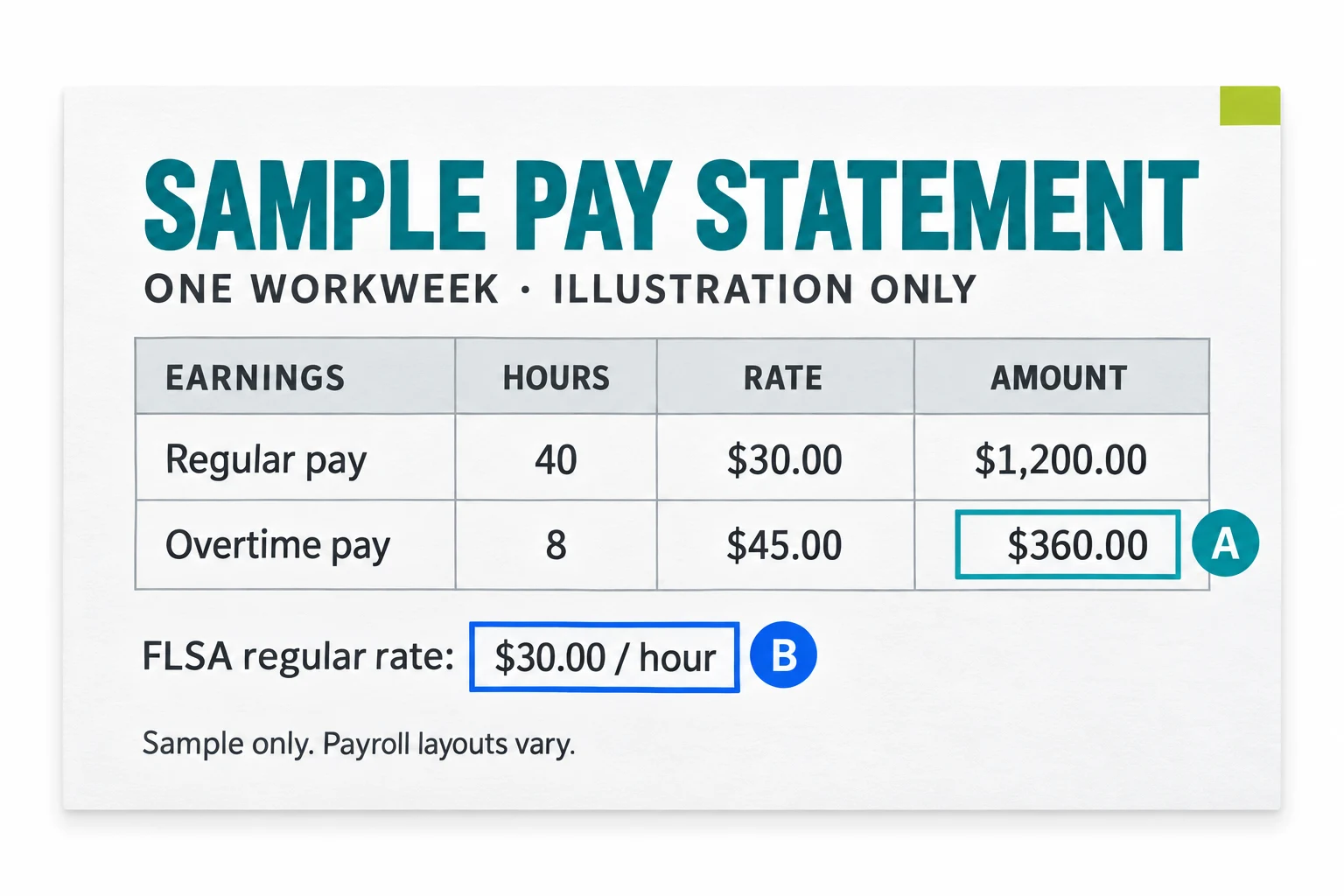
Qualified OT tracking in plain English
QuickBooks uses a Qualified Overtime Tracking pay type or payroll item to record qualified overtime compensation. That is the premium required by FLSA section 7 above the regular rate of pay, not all wages earned during overtime hours. A software label alone does not establish eligibility.
QualifiedOvertime.com provides a separate documentation workflow: compare your pay records, estimate the premium, and keep calculation notes for payroll or a tax professional. This website's workflow is not the definition of the QuickBooks payroll item and does not change your payroll records.
2025 transition records versus 2026 reporting
For tax year 2025 transition records, an employer may provide a W-2 Box 14 note, an employer statement, a payroll portal record, or pay stubs when qualified overtime compensation was not separately reported.
For tax year 2026, the official W-2 and W-3 instructions use Box 12 code TT to report the total amount of qualified overtime compensation. Keep the pay stub and payroll records that explain the reported amount.
If an issued 2026 W-2 omits or understates qualified overtime, request Form W-2c from your employer. A pay-stub estimate cannot replace that reporting; an uncorrected omitted or understated amount cannot count toward the deduction. If the reported amount is overstated, only the actual qualified amount paid can count.
What the QuickBooks tracking item does
QuickBooks documents a tracking item, not another wage payment. Changing only the tracking amount leaves net pay or taxes unchanged; changing other paycheck entries is a different action.
QuickBooks automatic calculation depends on the product, pay types, and FLSA-aligned setup. Some cases require manual entry or review; do not assume every QuickBooks amount was calculated automatically or correctly.
Other payroll systems may use different labels and calculations. Confirm their meaning with your provider. QualifiedOvertime.com is not affiliated with QuickBooks or any payroll provider.
Tracking has limits
Tracking does not prove you are eligible for the deduction. Not all overtime pay is qualified overtime compensation, and personal taxpayer rules still apply.
The estimate is before deduction caps, income phase-outs, filing-status rules, and Social Security number requirements. Overtime wages generally remain subject to federal income tax withholding, Social Security, and Medicare taxes; a tracking line does not make the paycheck tax-free.